

Differences between a ruggedized screen and a consumer screen
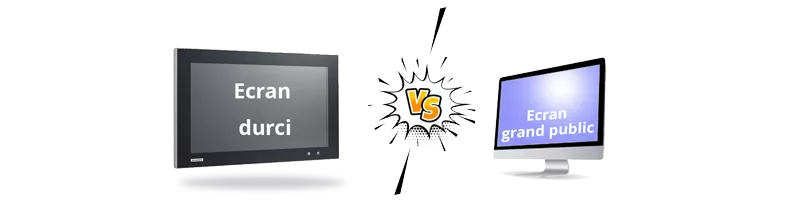
Screens have become essential in daily life for several years now. However, their application is not limited to private or recreational use. Professionally, these technological tools are indispensable resources for certain tasks.
They are then equipped with similar technologies, and generally designed on the same basis. However, they are also readjusted to suit the sector in which they are used or stored. Depending on professional constraints or their usage context, manufacturers add technical differentiations to better adapt them. That is why, in addition to standard screens, one can encounter rugged screens also referred to as hardened screens. If you wish to know everything about the type of screen suited to your environment or your daily usage, it is essential to be aware of the key differences between these two types of screens in order to make an appropriate and wise choice.
Reinforced screen or living room screen: which users?
At the outset, it should be noted that the consumer displays are intended for standard use and have standard usage norms. They are suitable for home use and are perfectly suited for individuals. They are widespread in the market and equip electronic devices such as tablets, televisions, smartphones... Generally, these displays are primarily used to watch videos, watch television, browse the internet, listen to music, play games… Thus, we find ranges like televisions, computer monitors, smartphone screens, tablet screens, ...
In contrast, the rugged displays are oriented towards professional use. They are part of families of reinforced IT products strengthened by rugged computing and all that concerns industrial computer hardware. To meet this need for robustness, the equipment uses parts and electronic components suited for use in a hostile environment.
They are generally adaptable based on the industry for which they are intended and have specific norms of their own. The criteria generally include: durability, resistance to moisture, waterproofing, shock and vibration resistance, ... This is why they are also referred to as industrial screens.
Meeting the specific needs of the industry sector, they are designed with various objectives based on their characteristics: to be suitable for mobility, for being sedentary, and to be used even in the most difficult and hostile environments. These monitors are used by industrialists, military bodies, underwater divers, researchers for technical work, or even reporters, cities, and metropolitan areas, ... For example, using a consumer display in an environment exposed to extremely high temperatures exposes the screen to damage to the device's circuits. For this reason, and under these working conditions, devices with hardened screens are preferable.
Professional versions are generally used in factories, production sites, public spaces, outdoors, in refrigerated areas, supermarkets, ...
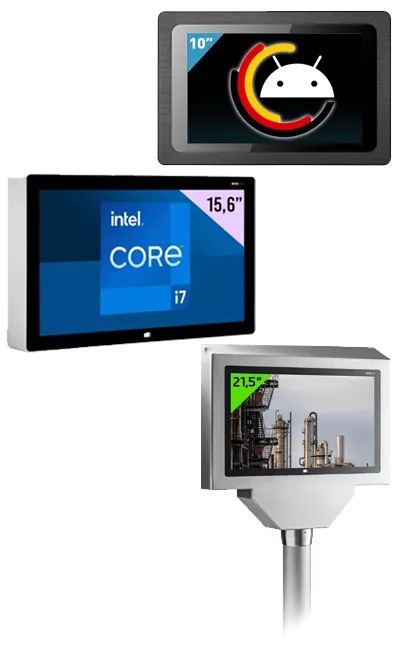
Rugged screen variants and consumer screen
It is important to note that reinforced screens can come in several variants depending on their panels. We distinguish between classic panels of LCD or LED technology for non-touch monitors. Otherwise, for hardened touch screens, we find resistive panels, capacitive panels, and projected capacitive panels.
In use, resistive panels have a plastic membrane on the surface and a touch membrane inside. This plastic panel provides greater resistance to water, dust, and greasy substances, but also allows the user to operate these screens even while wearing gloves. These screens are found at automated kiosks (bank, beverage) and at interactive terminals. Capacitive panels, on the other hand, are more responsive to touch but less shock-resistant. This type of panel is commonly found in screens for home use (tablets, smartphones, touch computers…).
However, following recent innovations in the field and thanks to the evolution of usage, more and more professional versions are available with capacitive technology also called "multi-touch". Just as hardened as resistive touch panels, it offers the possibility to introduce new uses for the industry.
The ATEX standard (ATmosphere EXplosive)
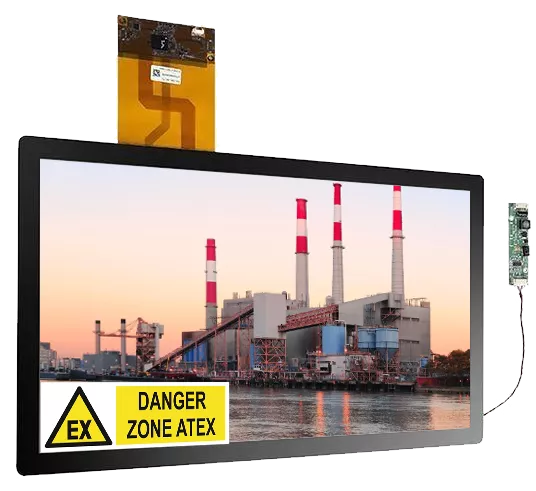
This technical indication is also a key point opposing these two types of screens. This criterion comes from a regulation of the European Union recommending a mastery of the inherent risks associated with conducting activities in areas presenting an explosion hazard. The danger level of the area is assessed on a scale of 0 to 2 regarding gases and vapors and from 20 to 22 for dust-related hazards.
In light of this recommendation, a hardened screen may have a protective coating (stainless steel for example) or thermal insulators according to the risk classification level related to the area. While it is true that some manufacturers are increasingly turning to the creation of screen models compliant with the ATEX standard, it must nonetheless be specified that screens delivered to the public are not suitable for these hazardous environments.
This type of certification is necessary in many activities.
The Ingress Protection (IP) Rating
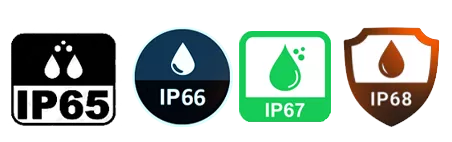
In view of a potential use in humid, dusty environments, subjected to constant cleaning or in environments with high ambient temperatures, an industrial screen must meet the criterion related to the protection rating. Indeed, the IP protection rating represents an indicator of the screen's ability to resist dust and liquids. It consists of two digits calibrated on a scale from 1 to 9. The first digit (ranging from 1 to 6) represents the degree of resistance to dust, while the second digit (established on a scale from 1 to 9) accounts for resistance to liquids. On this scale, a standard screen generally has a certification of IP 43.
In comparison, reinforced screens for optimal protection have a rating of greater than or equal to IP 65 or IP 67. This characteristic allows them to prevent any dust from entering and to be protected against the effects of pressure cleaning. Another peculiarity is that some versions only are IP65 on the front facade of the display panel, while the rest of the housing is only IP40. This generally ensures excellent immunity against liquids when the equipment is embedded. They are minimally ensured by an IP 40 certification.
Manufacturing Technical Standards

From a technical standpoint, manufacturing standards are a critical criterion for differentiation between rugged screens and conventional screens. In reality, designed to be particularly resilient, rugged screens must comply with strict resistance specifications during their design and assembly. Otherwise, they would be exposed to partial or complete deterioration and would also expose holders to potential dangers.
In particular, the range of MIL-STD-810 standards is an international reference defined by the U.S. Army. It takes into account certain criteria and comprehensive tests that justify the material's capability to withstand wear, dust, altitude, tolerable temperature, rust tolerance, mold, and saline environments, water resistance or depth of immersion, and durability. These criteria are complemented by a measurable magnitude referred to as Ingress Protection (IP) rating.
The quality of the screen
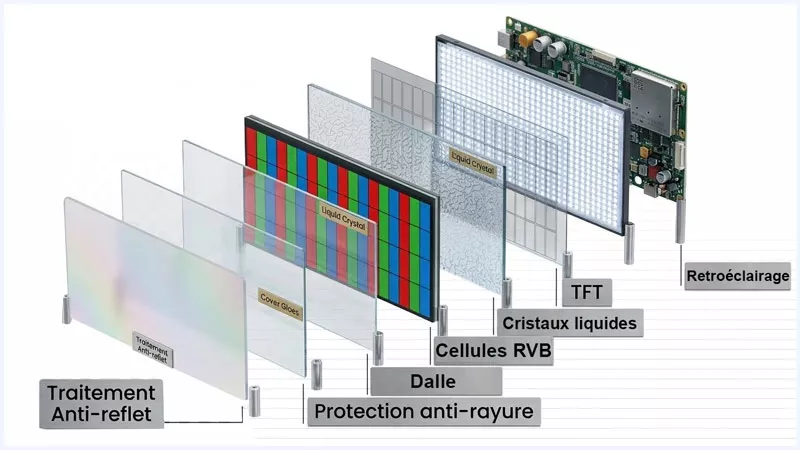
As we have emphasized, industrial machine screens are extremely resistant to shocks and scratches. Technically, this advantage stems from the quality of the glass covering the screen as well as the various protective layers that the panel is composed of.
More and more, materials protecting the reinforced screen come from various chemically tempered glass alloys to be just as resistant. This alloy is also designed to be perfectly readable in both high and low light conditions. In their segment, salon screens are not equipped with the same technology. Far from being comparable to an industrial screen in terms of shock resistance, they nevertheless possess some resistance to light shocks and scratches. In this regard, recent models are equipped with gorilla glass technology which is suitable for light impacts. For better readability in high and low light, these screens incorporate LED technology.
Aesthetic considerations
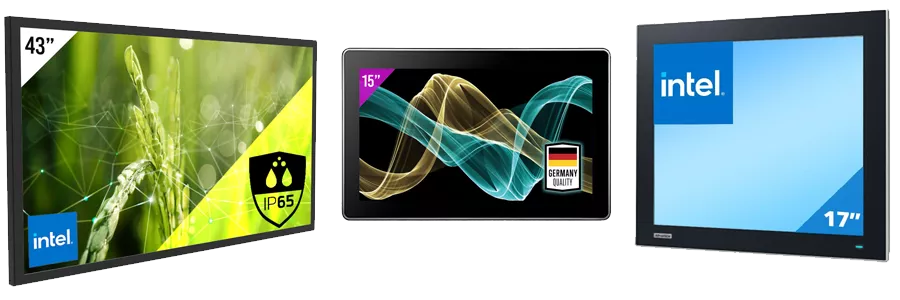
Aesthetically, it should be noted that household screens prioritize design and ergonomics, as manufacturers are aware of the importance of user comfort for the general public. Thus, these screens are designed to be increasingly lightweight, easily portable, and easily modular. An observable trend on these screens is the removal of physical buttons to provide them with the strict minimum of buttons possible. It should also be noted that this type of screen generally does not come equipped with many ports and connectivity options, unlike professional versions.
While we appreciate their unbreakable resistance, it is nonetheless true that reinforced screens are relatively heavy. Indeed, this weight is justified by the physical protections that equip these types of screens.
As consumer displays adapt to all budgets, rugged professional displays (Advantech, Winmate, etc.) represent a justified higher investment due to their high resistance, durability, the longevity of their components, and their customized technology: contact us now to get a personalized quote tailored to your industrial needs.