

Technical scoping and understanding of business needs
Our challenge: understand the need
Developing the right solution often starts by questioning the initial request
A functional specification often describes a proposed solution. It does not always present the problem that actually needs to be solved.
Our role is to understand your processes, your users, your constraints, and your existing environment before defining what the software should do and how it will integrate with your tools. And when we identify an inconsistency, a risk, or a more relevant alternative, we tell you.
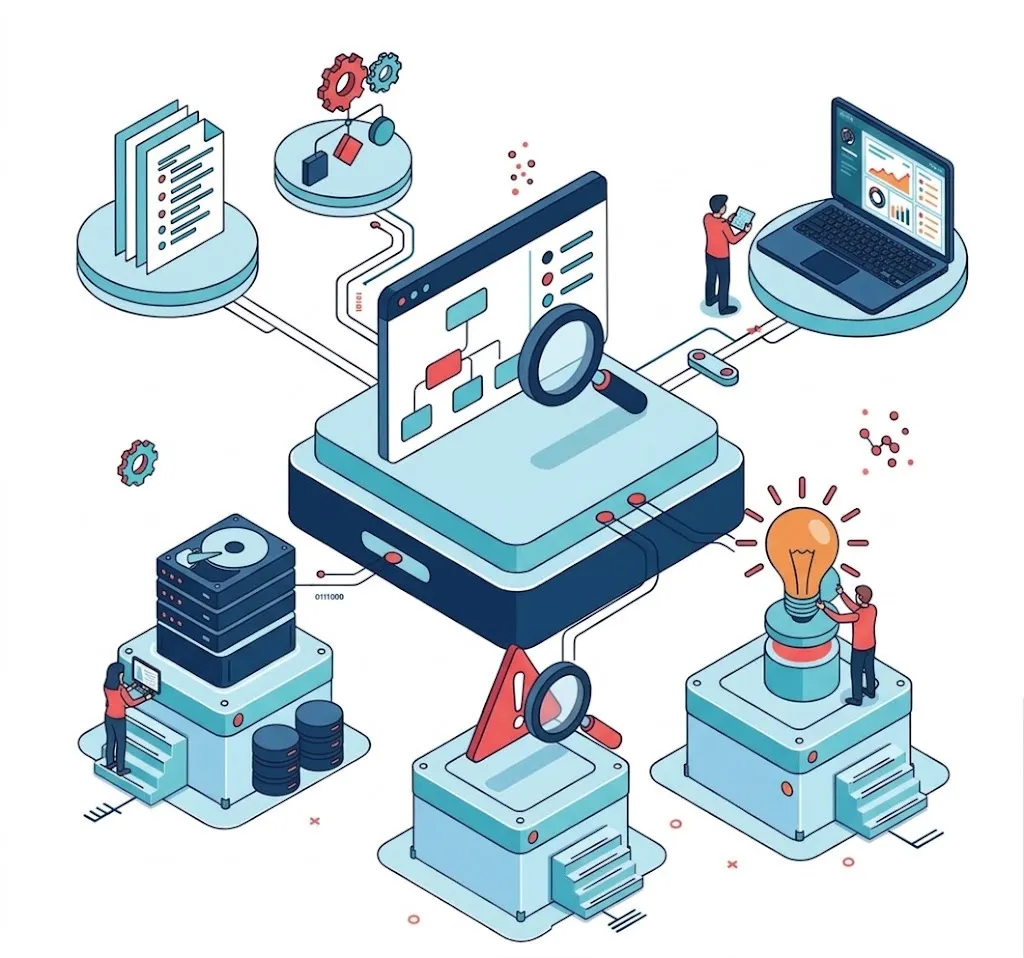
Good development can produce a bad tool
An application can be perfectly developed and yet ignored, avoided, or even forgotten by your teams. These are the consequences of the field test. An application can be neglected if:
it requires too many manipulations
requires an unavailable network
complicates a task that was previously simple
...
That's why we don't consider framing as a simple administrative step preceding development.
Understanding the profession is part of the engineering work.
Understand before specifying

Analyze the need and its context
We start by understanding what triggers the project. What problem are you trying to solve? Who is encountering this problem? How is it managed today? What data is used? What other tools are involved in the process? What happens when a step fails? These questions often reveal constraints that were not visible in the initial request.

Observe real usage
Between a theoretical process and its daily use, the differences can be significant. Your operators use computer tools in real-world conditions. We therefore integrate environmental and usage constraints: mobility, network availability, frequency of actions, equipment used, user skill level, or consequences of an error.

Transforming the need into useful specifications
The framing should gradually describe the expected functions, management rules, and criteria that will allow the software to be validated. Features, data, business rules, interactions with the information system, rights, specific scenarios, validation criteria, etc., are gradually addressed. The goal is to reduce areas of uncertainty before they become development errors.

Verify technical choices
A technical choice included in a specification document deserves to be reconsidered. Is a mobile application really necessary? Does a feature really need to be developed or does it already exist elsewhere in your IS? Does real-time synchronization bring real value? We provide constructive contradiction when it helps to secure the project.

Arbitrate with pragmatism
Budget, timeline, technical debt, external dependencies, and available resources are integral parts of the project's constraints. Our role also involves making trade-offs visible: distinguishing the essential from the desirable, building a realistic trajectory, and explaining the consequences of different options to enable you to make the right decisions.
You remain a decision-maker
We do not seek to lock the project in a technical black box.
We explain the main decisions, their advantages, their limitations, and their consequences so that your teams can make informed decisions. This method also helps create a common language between business teams, management, users, IT department, and developers.
Two concrete projects, two business realities
An application for healthcare professionals in the field
The crucial constraints of the application for home healthcare professionals: mobility and speed of use, offline functionality, strict data protection
Digitize waste collection without the limits of the existing
The keys to effective waste collection software: integration of real flows (field, traceability, management), simplification of processes rather than mere digitization
A useful framework regardless of the type of project
This approach applies equally to a new business web application, a mobile application, or the redevelopment of existing software. Our constant goal is to ensure the relevance of the solutions we offer.
You have a need, but not all the answers yet?
You don't have a specifications document yet? Let's start from your need, your users, and your current tools to define together the priorities and the next steps of your project.
Our teams at your service
We are here to help you as best as we can! Feel free to contact us via our form, by email, or directly by phone.

31 rue Ampère
69680 Chassieu, France

Monday to Friday, from 9am to 6pm