

Reliability and accountability for critical software projects
Secure decisions and make them last
The more critical an application is for your business, the greater the responsibility of those who design it.
When software drives a business process, centralizes important data, connects equipment, or becomes essential to daily operations, a technical decision can no longer be considered trivial.
We therefore prioritize reliable, explainable, and maintainable solutions, and we stand by the recommendations we make.
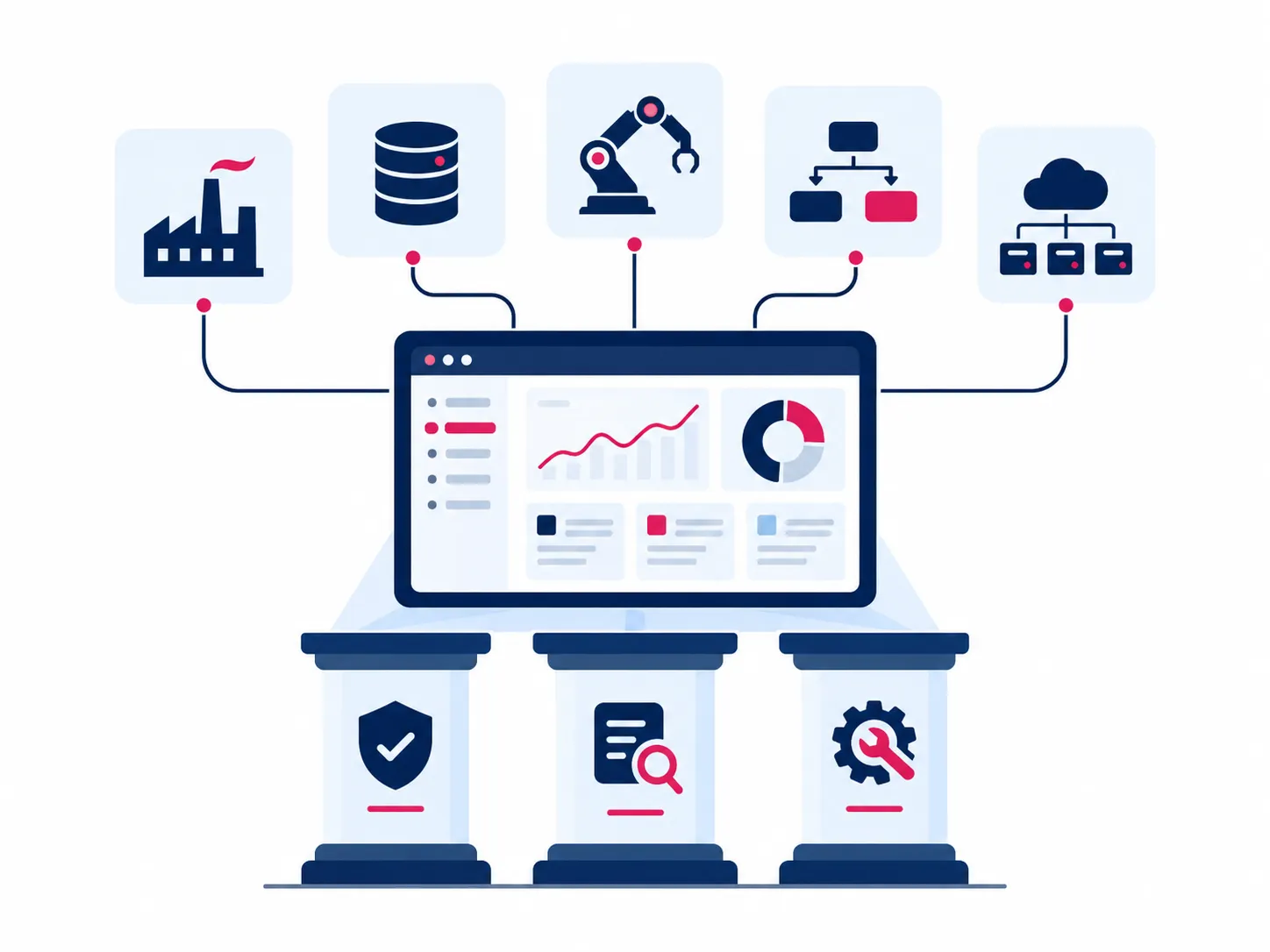
Being able to rely on your software, and on those who maintain it
The reliability of a project is not just about an application working on the day it goes live.
It also depends on its ability to withstand real-world use, to be understood by those who will need to work on it, to detect regressions, and to evolve without constantly questioning its functionality.
All of this stems from the vision guiding the project and the way decisions are made.
When responsibilities are diluted or decisions are opaque, weaknesses generally tend to reappear at the most critical moment.
Our commitments are reflected in the way we work

Reliability: Designing to Function Sustainably
We prioritize architectures, components, and methods suited to the project's level of criticality. Tests, data validation, error management, controlled deployments, or monitoring mechanisms are not just a finishing layer: they directly contribute to the solution's reliability. The goal is simple: reduce interruptions and manage the consequences of a regression or an incident.

Responsibility: Taking on Technical Decisions
We explain the structuring decisions and the risks we identify. When a choice has a limitation, we make it visible. When a request seems risky or counterproductive, we prefer to discuss it rather than execute it without reservation. This responsibility sometimes involves saying no, or recommending an alternative solution to the one initially considered.

Quality Requirement: Prevent Rather Than Correct
An error detected early almost always costs less than an error discovered several months after production deployment. We therefore aim to gradually integrate the necessary checks: reviews, automated tests when relevant, functional validation, code analysis, and deployment control. The goal: to reduce defects, regressions, and technical debt that gradually compromise a project.

Sustainable Engagement: Evolve Rather Than Restart
A business application is rarely finished. Uses change, the information system evolves, new equipment appears, and regulatory or security constraints progress. We therefore design projects with their evolution in mind and can intervene after production to maintain, secure, and enhance the developed solutions.

Independence: Recommend what truly serves the project
We are not looking to impose a technology because it would allow us to lock the project. When several options exist, our role is to present their advantages, constraints, and consequences. An open-source architecture, documented and manageable by the client, generally offers a better foundation for a project intended to last.
Quality takes on its full meaning when the software becomes critical
Let's take an infrastructure monitoring platform.
A functional evolution cannot be considered independently of the risk of disrupting the existing service. On the IoT portal that we took over, the redesign of the architecture and the addition of new features were therefore carried out while maintaining operational continuity.
The same principle applies in other contexts: health data, traceability of an industrial process, exchanges with an ERP, application used daily in the field.
Criticality is not necessarily related to the size of the project. It mainly depends on the consequences of an error or unavailability.
A relationship built on explainable decisions
Trust is not a promise that can be decreed at the beginning of a project.
It is built gradually: through the quality of exchanges, the ability to explain a choice, to acknowledge a constraint, to point out a risk, and to keep commitments made.
That's why we prefer to talk about responsibility, transparency, and sustainability rather than simply "customer proximity."
Take over an IoT platform through a rational strategy
Our approach takes on particular importance during a project takeover. Not everything existing is necessarily recoverable. And not everything needs to be rewritten either. Our responsibility then is to distinguish what can be preserved, what needs to be secured, and what actually constitutes a risk for the continuation of the project.
The same requirement, whatever your software project
Reliability, maintainability, and technical responsibility do not concern only the most complex projects. These requirements must guide the design as well as the evolution of any business solution.
Has your software become essential to your business?
Whether you want to develop a new solution, consolidate an existing one, or secure a project that has become critical, we can analyze with you the risks and strategic decisions to be made to sustain your investment.
Our teams at your service
We are here to help you as best as we can! Feel free to contact us via our form, by email, or directly by phone.

31 rue Ampère
69680 Chassieu, France

Monday to Friday, from 9am to 6pm